
Sentinel (not-the-real-name 😉) is an internal McKinsey tool that helps Partners identify and assess engagement risks before a project starts. It guides Partners through a structured questionnaire, analyses inputs against a risk framework and provides a clear “go or no-go” recommendation.
The platform has evolved to include AI-powered risk analysis, giving Partners and Risk Teams deeper, data-driven insights.
Role
Product Designer
Project type
Client
McKinsey & Company - Internal firm project
The Challenge
McKinsey needed a way to evaluate risks consistently across all client engagements. This included industry, geography, type of work and potential reputational exposure.
Risk assessment was previously manual and inconsistent, creating delays and potential oversight.
The goal was to design a digital, AI-enabled workflow that busy Partners would trust and adopt while satisfying the firm’s global risk governance requirements.
De-risking the firm effectively

Background Research
Interviewed Partners, Senior Partners and Risk Team members to uncover pain points in the current process.
Mapped the existing approval workflow to identify friction and clarify roles and hand-offs.
Reviewed global consulting risk frameworks to ensure alignment.
(Specific internal procedures and criteria are intentionally generalised.)
We examined common approaches to risk-management platforms across the professional-services industry.
Most existing solutions were either highly rigid, which slowed adoption, or too open-ended, which made it difficult to ensure consistent compliance.
These observations informed Sentinel’s goal of balancing ease of use with thorough, auditable risk assessment, while adding an intelligent AI layer for deeper insight.
Key Success Metrics Identified
The McKinsey consulting team came together and defined four key success measures:
Submission Time
Average time for a Partner to complete the risk questionnaire.
Approval Turnaround
Time from Partner submission to final Risk Team decision.
Compliance Accuracy
Percentage of engagements correctly flagged for review.
AI Insight Adoption
Frequency of Partners using the AI chat for deeper risk analysis.
Process
We applied the Double Diamond approach to guide the project from exploration to delivery. The method helped the team first broaden its understanding of the problem, then converge on clear solutions, and finally design and refine the product.
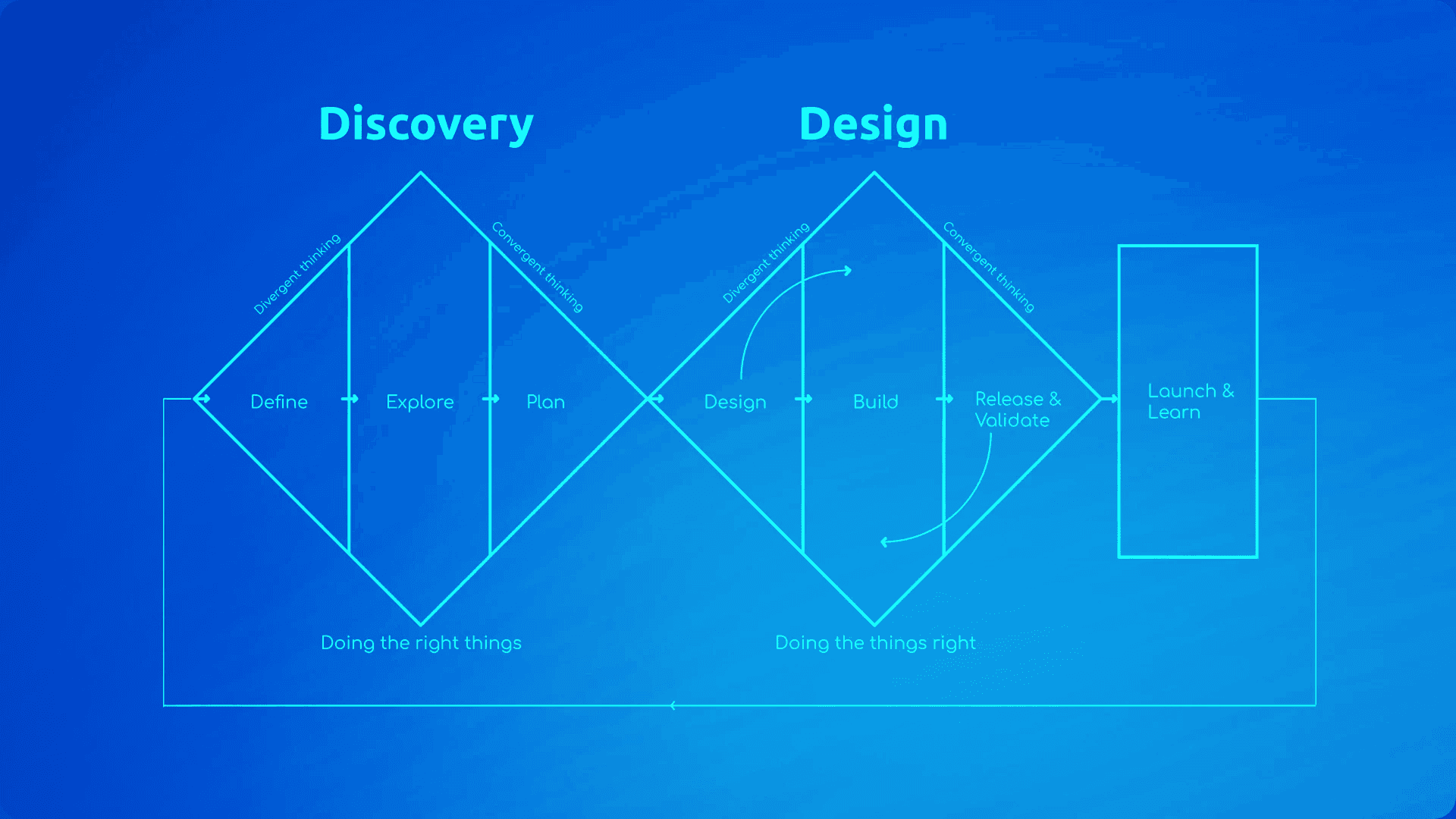
Discover (Divergent thinking)
Understanding the Problem
Conducted in-depth interviews with Partners and Risk Team members to uncover pain points and identify gaps in the existing risk-review process.
Mapped the current workflow to spot delays, duplicated checks and unclear hand-offs.


Define (Convergent thinking)
Framing the Challenge
Created key personas: Partner, Senior Partner Approver and Risk Analyst.
Synthesised research findings to articulate the core challenge: create a fast, trustworthy and globally consistent risk-assessment tool.
Prioritised features and established success metrics to guide design decisions.
Develop (Divergent thinking)
Exploring Solutions
Outlined questionnaire logic to capture industry, geography, type of work and classification.
Planned the AI analysis layer to combine internal engagement history with publicly available company data such as litigation records, regulatory actions and bankruptcy filings.
Produced low-fidelity wireframes for both the step-by-step questionnaire and the AI chat interface.


Deliver (Convergent thinking)
Finalising and Launching
Prototyped the automated routing system: Partner submits → Senior Partner approves → Risk Team analyses.
Designed dashboards for Partners to track submission status and for Risk Teams to view flagged engagements.
Ran iterative usability testing to refine flows and ensure the experience met the agreed success measures.
AI-Driven Features
Together with Shell stakeholders, we defined four success measures:
In 30 days of testing and observance
Pattern analysis
Identify subtle changes in complex datasets
Real-TIme Monitoring
Continuously monitor project data, providing latest risk insights.
Predictive Capabilities
Enables proactive risk management rather than reactive responses
Outcome
Streamlined risk assessment: engagement-approval cycle time reduced by more than half.
Consistent compliance: firm-wide application of risk standards across industries and geographies.
AI-powered insight: Partners quickly identify hidden reputational or legal risks and can escalate high-risk engagements early.
High adoption: Sentinel has become the default starting point for all new client engagements and for risk conversations across practices.

Reflection
Lessons learnt
Sentinel shows how advanced AI and thoughtful UX design can simplify complex risk governance. By combining a guided questionnaire with automated routing, transparent dashboards and an AI-driven risk advisor, the platform enables McKinsey teams to detect and understand risks early and to make confident go or no-go decisions while protecting both the firm and its clients.